US, EU, and UK conversion charts aren't universal since these systems use fundamentally different scale increments. A matching size label on the box doesn't guarantee a proper fit: the variance between a European Paris Point and the Anglo-American barleycorn system can throw off sizing by up to 4–6 mm for the exact same nominal size.
Why box sizes don't match: The math behind the three sizing systems
To understand why a size 10 US sneaker suddenly feels tight or a 43 EU dress shoe feels sloppy, you have to look at the baseline units driving each regional standard.
European System (EU / Paris Point):
- 1 Paris point = 2/3 cm ≈ 6.67 mm
- The scale starts from zero, but includes a built-in last allowance (functional allowance).
British System (UK / Barleycorn):
- 1 barleycorn = 1/3 inch = 8.46 mm
- The scale starts from children's size 0 (4 inches / 101.6 mm).
- The children's sizing runs up to 13 UK, before resetting to adult size 1 UK.
American System (US):
- The base step matches the UK system (1/3 inch = 8.46 mm),
- but the zero point is offset relative to the UK by 1/12 inch (~2.11 mm) or shifted by a full size up depending on the category (men's, women's, children's).
The core conversion glitch
The European step (6.67 mm) doesn't evenly divide into the UK/US step (8.46 mm). Over a 10-size span, this creates a desync of nearly 1.8 cm. That's precisely why a straight conversion like "EU 42 = US 9" results in a return rate of around 30%.
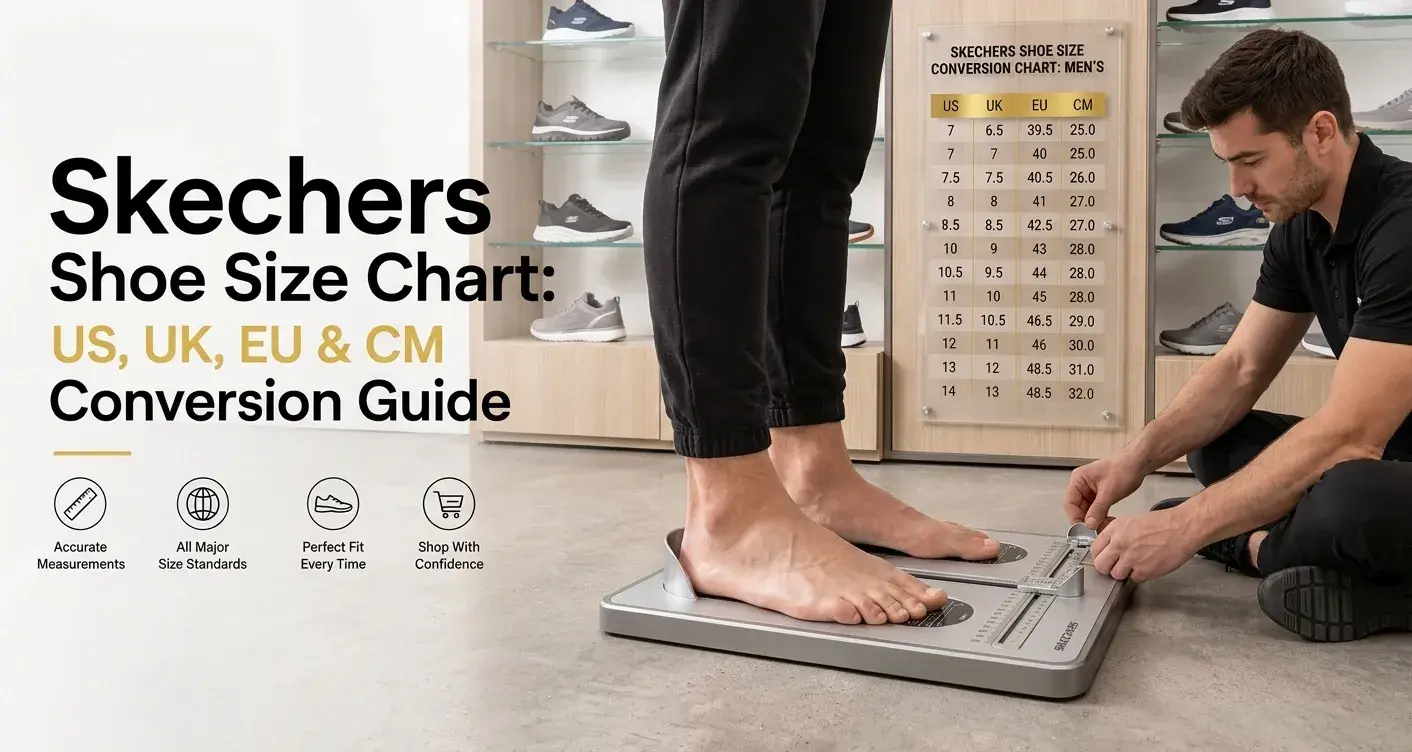
Men's and women's size conversion table (US / UK / EU / CM)
The table below outlines standard benchmarks for regular width profiles:
Men's & Unisex Footwear
| Foot Length (cm) | US (Men's) | UK | EU | Mondopoint (mm) |
|---|---|---|---|---|
| 24.5 | 6.5 | 5.5 | 39 | 245 |
| 25.0 | 7.0 | 6.0 | 40 | 250 |
| 25.5 | 7.5 | 6.5 | 40.5 | 255 |
| 26.0 | 8.0 | 7.0 | 41 | 260 |
| 26.5 | 8.5 | 7.5 | 42 | 265 |
| 27.0 | 9.0 | 8.0 | 42.5 | 270 |
| 27.5 | 9.5 | 8.5 | 43 | 275 |
| 28.0 | 10.0 | 9.0 | 44 | 280 |
| 28.5 | 10.5 | 9.5 | 44.5 | 285 |
| 29.0 | 11.0 | 10.0 | 45 | 290 |
| 29.5 | 11.5 | 10.5 | 45.5 | 295 |
| 30.0 | 12.0 | 11.0 | 46 | 300 |
Women's Footwear
| Foot Length (cm) | US (Women's) | UK | EU | Mondopoint (mm) |
|---|---|---|---|---|
| 22.0 | 5.0 | 3.0 | 35.5 | 220 |
| 22.5 | 5.5 | 3.5 | 36 | 225 |
| 23.0 | 6.0 | 4.0 | 36.5 | 230 |
| 23.5 | 6.5 | 4.5 | 37 | 235 |
| 24.0 | 7.0 | 5.0 | 37.5 | 240 |
| 24.5 | 7.5 | 5.5 | 38 | 245 |
| 25.0 | 8.0 | 6.0 | 38.5 | 250 |
| 25.5 | 8.5 | 6.5 | 39 | 255 |
| 26.0 | 9.0 | 7.0 | 40 | 260 |
Key grid differences: The hidden catches retailers don't talk about
Directly mapping US sizes to EU using generic tables often breaks down due to the non-linear scaling between systems.
- Men's vs. Women's US sizing: In the US, women's sizes are offset from men's by roughly 1.5 sizes. For instance, a women's US 8.5 matches a men's US 7.0 in insole length. Meanwhile, the UK system has almost no such gender split: a men's and women's UK 6 typically share the exact same last length.
- Inconsistent EU increments: The gap between whole EU sizes is a single Paris Point (~6.67 mm). In US and UK scales, whole sizes step by 1/3 inch (~8.46 mm), with half-sizes moving by 1/6 inch (~4.23 mm). Because of this math, a flawless 1:1 cross-system mapping doesn't exist—brands are forced to round off values.
- Foot length vs. insole length: European manufacturers list the last size on the box, which includes a functional movement allowance (around 5–10 mm). If your foot measures exactly 27 cm, an EU 42 might feel snug since its internal physical capacity is engineered for 27.3–27.5 cm.
Width Sizing (Width Code)
Length is only half the fit equation. Width is denoted by letter codes widely used by American and European premium footwear brands:
- A / B (Narrow): Narrow foot profile. In women's lineups, B is treated as the standard width.
- D (Medium / Standard): Standard width for men's footwear. In women's lines, D indicates an expanded width.
- E / 2E / EE (Wide): Wide foot profile with extra volume across the instep.
- 4E / 6E (Extra Wide): Designed for athletic or orthopedic footwear built for high-volume, extra-wide feet.
Brand-to-Brand Last Variations
Brands rely on their own proprietary wooden or plastic physical lasts.
- Nike: Traditionally snug and narrow through the midfoot. They frequently require sizing up by +0.5 relative to standard EU grids.
- Adidas: Features a wider toe box, though their EU grid scales in 1/3 increments (40, 40 2/3, 41 1/3, 42, 42 2/3).
- New Balance: Strictly adheres to the US Brannock standard, where CM metrics almost always reflect actual insole length.
Step-by-Step Foot Measurement Guide
- Timing: Measure your feet in the afternoon or evening when they swell slightly, expanding in volume by 3–5 mm.
- Gear: Put on the exact socks you plan to wear with the footwear (e.g., thick hiking socks for boots or thin dress socks).
- Positioning: Place a sheet of paper on the floor with one edge against a flat vertical wall. Stand with your heel pressed against the wall. Hold a pencil strictly perpendicular to the floor and trace the outermost toe point (not always the big toe—frequently the second toe).
- Measurement: Measure the distance from the edge of the paper (the wall) to the furthest marked point. Measure both feet and base your sizing on the larger measurement.
- Buffer: Add 5 mm to your measured length for daily casual wear, and 10–12 mm for running shoes or winter boots.
Retail Insight: A length disparity between the left and right foot occurs in roughly 85% of people. Always measure both feet and size up to the larger one.
Key Brand Sizing Nuances
When translating sizing charts to real-world products, discrepancies happen due to the proprietary last standards of specific factories and brands.
Nike
- Specifics: The brand prioritizes athletic lockdown, meaning their sneakers often feel snug in the forefoot (toe-flex area).
- Pro Tip: When converting from EU to US sizing, size up by 0.5 from your baseline. If your actual foot measurement is 27.0 cm, standard charts point to a 9 US, but lines like Air Max or Pegasus call for a 9.5 US (43 EU in Nike’s ecosystem) for a comfortable fit.
Adidas
- Specifics: Fractional EU sizing stepping in $1/3$ Paris points ($40, 40\frac{2}{3}, 41\frac{1}{3}, 42, 42\frac{2}{3}, 43\frac{1}{3}$).
- Pro Tip: Don't look for a "clean" 42 or 43 in Adidas charts—they literally don't exist in production. Stick to UK values or foot length in millimeters. An 8.5 UK in Adidas maps directly to 42.6 EU ($42\frac{2}{3}$) and a 26.5 cm foot length.
New Balance
- Specifics: One of the few brands offering major popular models (like the 574, 990, and 1906) in multiple width options.
- Width Options:
- D: Standard men's width.
- 2E: Wide fit (increases forefoot girth by 8–10 mm while maintaining the same insole length).
- 4E: Extra-wide fit.
- Pro Tip: If you have wide feet, grabbing a 2E width in your true length saves you from having to size up by 1–1.5 sizes.
Material & Construction Impact on Sizing
Upper material physics significantly change how shoes behave over time:
- Full-Grain Leather: Stretches wider during break-in (at peak pressure zones), but never stretches in length. Leather footwear can be bought with a minimal functional allowance (5 mm).
- Suede and Nubuck: Stretch more aggressively than full-grain leather. A snug initial fit is totally fine when breaking in soft suede loafers or sneakers.
- Synthetic Mesh and TPU: Zero stretch memory. Sneakers built with rigid polymer cages (like trail or basketball kicks) won't break in over time. The size you try on is what you're stuck with for the life of the shoe.
Real-World E-Commerce & Logistics Case Study
Issue: A buyer orders Italian-made men's dress shoes in a 42 EU, assuming they match their Nike running shoes labeled 42 EU (8.5 US / 26.5 cm). The delivered pair turns out 1.5–2 cm longer in the insole and slides right off their feet.
Root Cause:
- In classic European footwear (especially Italian and British builds), a 42 EU is stamped without factoring in elongated toe boxes (sleek lasts). The actual physical insole length in these dress shoes can hit 28.5 cm even when engineered for a 27.0 cm foot.
- Nike 42 EU running sneakers feature a physical insole length of 26.5–27.0 cm, factoring in plush heel padding.
Solution: For classic leather European shoes, size down by 1–1.5 sizes compared to your athletic sneakers.
Pre-Checkout Online Sizing Checklist
- Measure both feet while standing at the end of the day.
- Take the max measurement and add your functional allowance (5 mm for casual footwear, 10 mm for athletic/trail gear).
- Look up the cm/mm value under the JP / CM / Mondopoint column on that specific brand's chart.
- Cross-reference that metric with the regional code (US, UK, or EU) on the product page.
- Check reviews for that exact model for fit feedback (look for tags like "True to size," "Runs small," or "Runs large").
Frequently Asked Questions (FAQ)
What if my size falls right between two numbers?
For casual and athletic kicks, always go with the larger size. An extra 3–4 mm is easily managed with laces or a snug insole. You can't stretch a small shoe lengthwise without blowing out the stitching and trashing the heel counter geometry.
Why is the JP / CM label on a sneaker tongue more reliable than US or EU?
The Japanese (JP) size indicates length in millimeters or centimeters. 90% of the time, it's the raw physical length of the foot or insole, stripped of arbitrary units like Paris points or barleycorns. If you know your foot length in centimeters, trust the JP/CM column.